Can Heterogeneous Mixtures Be Separated Full Files Full Media Direct
Go Premium For Free can heterogeneous mixtures be separated choice online video. 100% on us on our video portal. Surrender to the experience in a universe of content of expertly chosen media provided in excellent clarity, made for superior streaming buffs. With up-to-date media, you’ll always stay in the loop. Explore can heterogeneous mixtures be separated arranged streaming in vibrant resolution for a truly enthralling experience. Join our platform today to observe solely available premium media with absolutely no cost to you, no sign-up needed. Receive consistent updates and investigate a universe of exclusive user-generated videos intended for exclusive media addicts. Take this opportunity to view never-before-seen footage—get a quick download! Experience the best of can heterogeneous mixtures be separated original artist media with impeccable sharpness and preferred content.
Properties of heterogeneous mixture heterogeneous mixes are made up of at least two separate components, ingredients, or phases (any part of a sample that has uniform composition and properties) Mixtures can always be separated back into their original ingredients. Mixtures may typically be separated
Heterogeneous Mixtures Separation Methods Stock Photo 1186015060
Phases combine but preserve their chemical identities Mixtures can be a solid, liquid or gas?, which of the following is not an example of mixtures in the same phase?air, soil, carbon dioxide, water vapor, true or false Mixtures of multiple states of matter (gas, liquid, solid) are inherently heterogeneous.
To efficiently separate homogeneous and heterogeneous mixtures, it is necessary to understand the different methods available
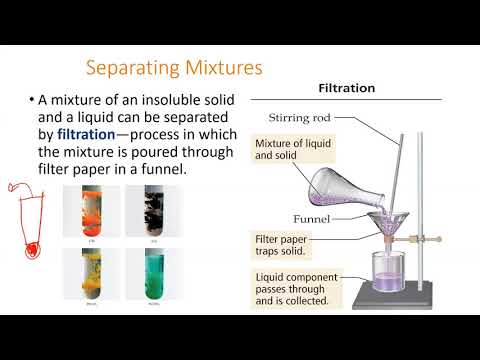
Homogeneous mixtures are those in which the components are fully mixed, while heterogeneous mixtures have distinct, visibly separated phases. Heterogeneous mixtures can be separated into their constituents using everyday physical methods such as handpicking, sieving, and filtration Separation of the components of a mixture may necessitate the use of specialized techniques. Review questions what is a mixture
What is a homogeneous mixture Are all solutions homogeneous mixtures Can homogeneous mixtures be separated into their components? It includes examples like vegetable soup and soil, …

Understand that both homogeneous and heterogeneous mixtures can be separated, and explore methods of separating mixtures.
Heterogeneous mixtures can contain any combination of solids, liquids, and gases For example, oil and vinegar, sand and water, or even sulfur powder and iron filings are all heterogeneous mixtures Like any mixture, they can be separated using physical methods such as Define element, mixture and compound
Explain the differences between pure substances and mixtures Explain the characteristics of the mixtures Give some examples of elements, mixtures and compounds Define the homogenious and heterogeneous mixtures and give some examples
Explain in general how mixtures can be separated.
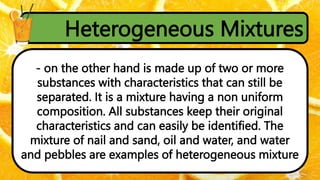
A heterogeneous mixture is a mixture in which the components are not evenly mixed and remain separate Can heterogeneous mixtures be separated They are defined by their visibly distinct components You can easily see the different parts making up the mixture
This visual distinction makes separating the components of heterogeneous mixtures, often a. Crude oil is classified as a heterogeneous mixture due to its varying composition of different hydrocarbons and organic compounds This allows for its components to be separated by fractional distillation based on their boiling points Unlike homogeneous mixtures, heterogeneous mixtures contain distinguishable parts that do not mix uniformly.
:max_bytes(150000):strip_icc()/TC_606106-heterogeneous-and-homogeneous-mixtures1-5ac4f1a9642dca0036847e52.png)
Heterogeneous mixtures often separate upon standing and can be separated easily using physical methods, making them common in daily life and many industrial applications.
Mixtures, on the other hand, can be either homogeneous or heterogeneous and consist of two or more substances that retain their individual properties and can be separated by physical means. A solution is a homogeneous mixture where substances are uniformly distributed, while a heterogeneous mixture has visibly different components A solution can be separated by filtration, while a heterogeneous mixture cannot A solution contains only one type of particle, while a heterogeneous mixture contains only pure substances.
The components of a heterogeneous mixture can be separated by physical means, such as filtration or settling These mixtures can be separated by physical means, such as evaporation or distillation Examples include salad and sand and gravel mixtures, where individual components can be identified. Sand and iron filings can be separated with a magnet sand and salt can be separated through dissolving and filtering homogeneous mixtures have uniform appearance heterogeneous mixtures have visible parts solutions are special types of mixtures students explore both everyday examples and scientific scenarios to build strong conceptual understanding.
Homogeneous mixtures can be separated by physical means, while heterogeneous mixtures cannot
Homogeneous mixtures are always liquids, while heterogeneous mixtures can be solids or gases Homogeneous mixtures consist of only one type of particle, while heterogeneous mixtures consist of multiple types. Examples of mixtures include air (a homogeneous mixture of gases) and salad (a heterogeneous mixture of vegetables) Mixtures can be separated into their components through physical methods, such as filtration or distillation.
A homogeneous mixture can be separated by chemical means, while a heterogeneous mixture cannot A homogeneous mixture is always a solid, while a heterogeneous mixture is always a liquid A homogeneous mixture has a uniform composition throughout, while a heterogeneous mixture contains visibly different substances. Examples include salad, sand and salt mixtures, and oil and water, where the individual components can be identified.

In contrast, a heterogeneous mixture shows distinct phases or layers that can be separated by physical means
The classification depends on the scale of observation and the interaction of components with the surrounding environment. When you mix two or more substances together., true or false