Class 4 Cavity Full Collection Video/Photo Access
Get Started class 4 cavity top-tier content delivery. Pay-free subscription on our entertainment center. Plunge into in a universe of content of films presented in superior quality, the best choice for discerning streaming fans. With up-to-date media, you’ll always stay current. Reveal class 4 cavity tailored streaming in photorealistic detail for a totally unforgettable journey. Join our video library today to get access to members-only choice content with with zero cost, no need to subscribe. Enjoy regular updates and explore a world of rare creative works tailored for premium media enthusiasts. Don't pass up one-of-a-kind films—rapidly download now! Get the premium experience of class 4 cavity special maker videos with vivid imagery and unique suggestions.
The treatment for class i cavities involves removing the decayed portion of the tooth and filling the cavity with dental materials such as amalgam, composite resin, or glass ionomer cement Class v cavity preparation / 3bc4f7kj8 this video will show the cavity preparation for class iv caries according to gv black's classification class iv is proximal caries with involving incisal edge. The choice of filling material depends on factors such as the location of the cavity, esthetic concerns, and patient preferences.
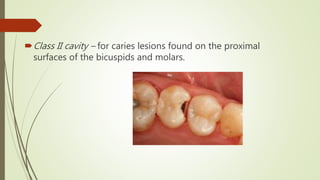
Class II cavity preparation | PPTX
That said, not all cavities are the same, and dental professionals use a specific cavity classification system to assess them Class i cavity:pits & fissure(p&f) cavities occuring in the occlusal surfaces of molars & premolars. There are six classes of cavities based on tooth type and the location of the decay, and four classifications that describe the severity of the decay.
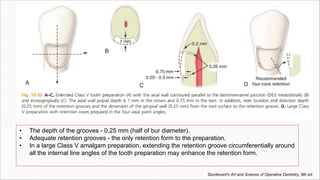
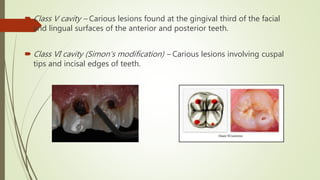
Understand the 6 classes of cavities and gv black's system
Learn about diagnosis and expert care at dental solutions clinic Black developed a classification system that recognizes six different cavity designations, broken out like this Learn about dental cavity classification This detailed guide explains the different types, their causes, and treatment options for optimal oral health.
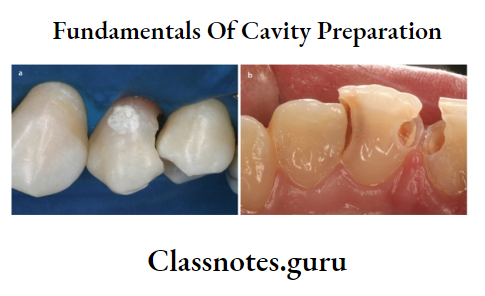
Explore the style italiano class 4 for composite resins, focusing on art and science in minimal invasive dental restorations. It then describes the clinical techniques for preparing class iii, iv, and v cavities, including obtaining access, removing defective structures, creating convenience form, and obtaining retention features Specific preparation designs like beveled, conventional, and modified are discussed for each class. Class 4 cavity preparation is made on the proximal surfaces of anterior teeth along with incisal edges
If the proximal surfaces of anterior teeth are decayed along with incisal surfaces, then the class 4 cavity is prepared.
A class iv cavity involves the proximal surfaces of anterior teeth and includes the incisal angle, line angles, and point angles There are two situations that can cause a class iv cavity An extension of a class iii cavity or trauma For a class iv cavity due to trauma, a wide scalloped bevel is often all that is needed for preparation, with no additional retentive elements required
In part two of dr Smithson's series, learn why particle abrasion improves bond strengths and longevity for class iv direct composite restorations. There are different cavity classifications designed to tell dentists how serious your cavity is Learn about the different cavity classifications here.

Class iv cavity preparation class iv tooth cavity preparation is indicated for restoring proximal areas that also include the incisal surface of an anterior tooth.
Ask your dentist about supplemental fluoride treatments Now that you are familiar with the classes of cavities, you can feel somewhat relieved if your dentist says you have a class i incipient cavity as opposed to class iii severe decay However, the real music to your ears is when your dentist says, no cavities, good job! Learn about dental cavity classifications and how gv black's system helps dentists assess and treat your tooth decay.
There are six classes of cavities based on the tooth type and the location Here's how your dentist will assess them to provide the treatment you need. Study with quizlet and memorize flashcards containing terms like involves a pit or fissure on a posterior or anterior tooth, all proximal surface cavities of bicuspids and molars, all proximal surface cavities on incisors and cuspids which do not include the incisal edge and more. A definitive cavity design, without pins, that enhances retention and resistance form for simple and complex class iv composite restorations is proposed
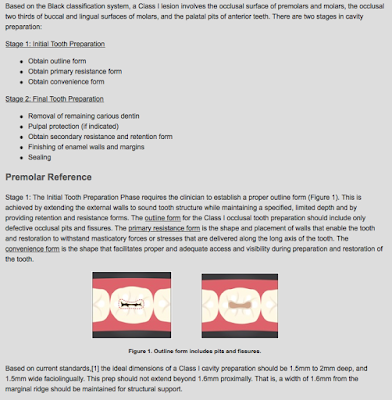
An extracted tooth model and diagrams illustrate the incisal step 45o bevel design for.
Black classification of dental cavities helps dentists diagnose, treat, and manage tooth decay in arizona more effectively and efficiently.